Creative / Non-QM
Can You Get a Mortgage in Florida With a Work Visa? What Changed in 2026
Buying a Florida home with a work visa? Learn conventional vs. FHA eligibility, Fannie Mae rules, ITIN requirements, and how October 2026 EAD changes may affect your mortgage.
Published October 15, 2026
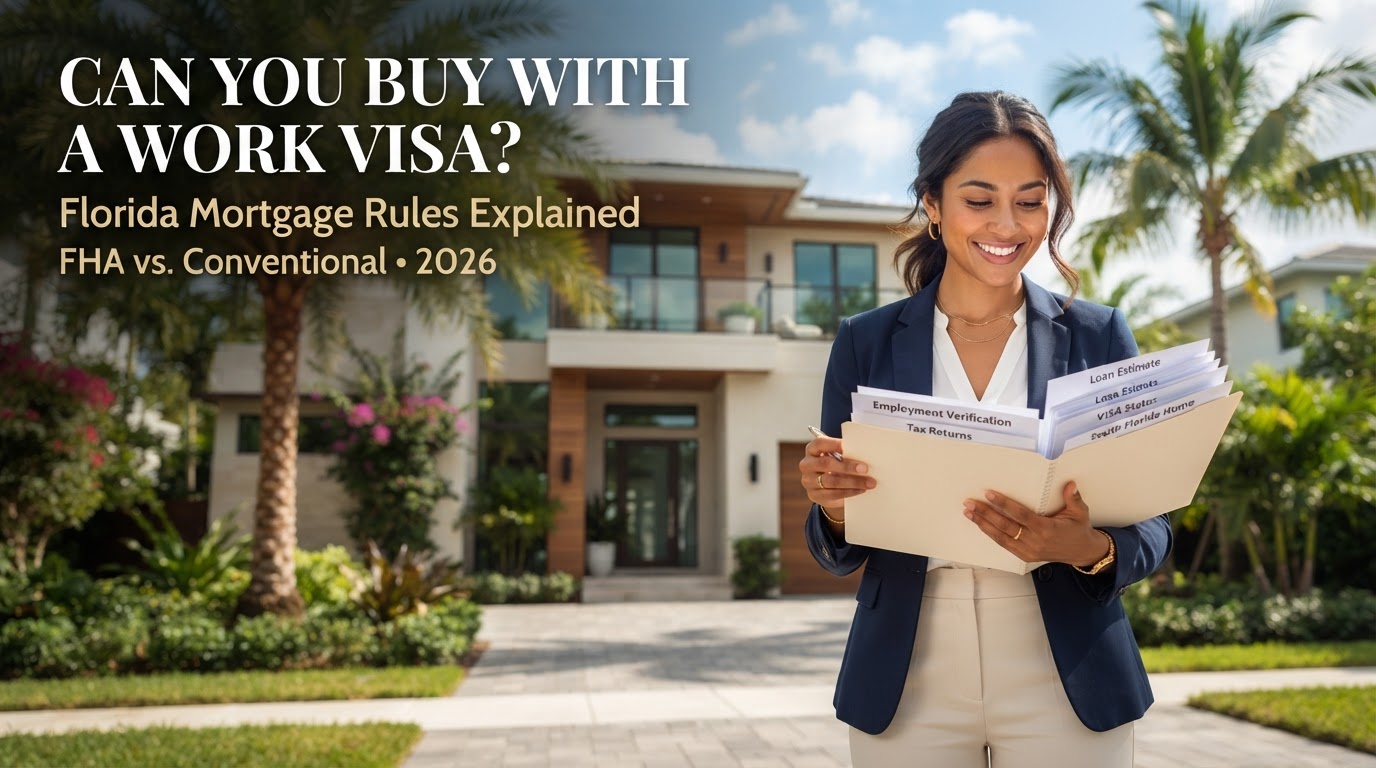
Yes. A non-U.S. citizen who is lawfully living and working in Florida may be able to qualify for a conventional mortgage without having a green card. Fannie Mae permits eligible lawful permanent and non-permanent residents to obtain conventional financing. FHA follows different residency rules, and an October 14, 2026 federal rule also changed how certain Employment Authorization Document renewals are treated.
For homebuyers living in Miami, Fort Lauderdale, West Palm Beach and elsewhere in Florida, the important question is not simply whether you are a U.S. citizen. It is: which mortgage program fits your actual residency, employment, income and financial profile? A work visa does not automatically prevent homeownership, but conventional mortgage options in Florida and FHA mortgages do not treat every residency category the same way.
What changed with work authorization in October 2026?
On October 14, 2026, the Department of Homeland Security finalized a rule titled Removal of Automatic Extensions for Certain Employment Authorization Documents. The rule confirms restrictions originally introduced on October 30, 2025. For certain Employment Authorization Document (EAD) renewal applications filed on or after October 30, 2025, simply filing the renewal does not automatically extend employment authorization for the previous up-to-540-day period.
Important exceptions remain. Certain extensions may still exist under separate law or specific Federal Register notices, including applicable Temporary Protected Status provisions. Applications filed before October 30, 2025 may also fall under the prior automatic-extension framework.
Why does this matter for a mortgage?
Mortgage lenders evaluate whether qualifying income is reasonably expected to continue. If a borrower's continued employment depends on an EAD that is approaching expiration, the lender may need to review current employment authorization, expiration date, renewal documentation, applicable extension rules, and whether qualifying income can reasonably continue. An expiring EAD does not automatically mean a mortgage application fails — the borrower's specific category and documentation matter. Not every work-visa holder relies on a separate EAD; some immigration classifications provide employment authorization through the underlying status. For immigration-specific questions, borrowers should consult qualified immigration counsel.
Can an H-1B visa holder qualify for a conventional mortgage?
Potentially, yes. Fannie Mae permits eligible non-U.S.-citizen borrowers who are lawfully present in the United States to obtain conventional mortgages. This includes qualifying permanent residents and qualifying non-permanent residents. Fannie Mae also requires non-U.S.-citizen borrowers to satisfy the same applicable employment and income-verification standards as U.S.-citizen borrowers.
So imagine a professional who lives in Miami, is legally present in the United States, works for a U.S. employer, has qualifying income, has acceptable credit and assets, and can document the applicable residency status. That borrower may potentially qualify for conventional financing. Examples worth reviewing can include borrowers in classifications such as H-1B, L-1, TN, E-2, O-1, and other qualifying lawful classifications. The classification itself is not a mortgage approval — the lender must still analyze the complete loan.
Does Fannie Mae require one specific immigration document?
Fannie Mae places responsibility on the lender to determine that a non-U.S.-citizen borrower is legally present in the United States using appropriate documentation. Depending on the borrower, documentation may include a passport, visa or immigration-status documentation, Form I-94, employment-authorization documents, or other applicable evidence. The appropriate documentation depends on the borrower's circumstances, and lender overlays can differ. Someone should not assume that one lender's documentation process represents every conventional lender in the market.
Can someone on a temporary work visa use FHA financing?
This is where conventional and FHA rules differ significantly. HUD revised FHA residency requirements through Mortgagee Letter 2025-09. Under the current policy, the non-permanent-resident borrower category was removed from FHA eligibility, and that change became mandatory for applicable FHA case numbers assigned on or after May 25, 2025.
As a result, a borrower who is lawfully present under a temporary work-visa classification but does not have lawful permanent-resident status will generally not qualify for a new FHA-insured mortgage under the current non-permanent-resident framework. That does not mean the borrower cannot obtain a mortgage — it means FHA may not be the correct program, and conventional financing may still be worth evaluating.
What about green-card holders?
Lawful permanent residents may potentially qualify for FHA financing. HUD states that qualifying lawful permanent residents can receive FHA-insured financing under the same applicable requirements, terms and conditions as U.S. citizens. FHA also recognizes certain citizenship categories under the Compact of Free Association. So the statement "you must be a U.S. citizen to get an FHA loan" would be inaccurate — citizenship alone is not the determining issue. The borrower's residency category matters.
Conventional vs. FHA for non-U.S.-citizen borrowers
A simplified comparison:
| Borrower type | Conventional | FHA |
|---|---|---|
| U.S. citizen | Potentially eligible | Potentially eligible |
| Lawful permanent resident | Potentially eligible | Potentially eligible |
| Lawful temporary work-visa holder | May potentially qualify | Generally not eligible under current policy |
| Overseas foreign-national buyer | Usually requires a different analysis | Usually requires a different analysis |
A buyer who lives outside the United States and is purchasing Florida property as an international buyer is not necessarily the same type of borrower as someone who already lives and works legally in Florida. A foreign-national or specialty mortgage program may be more appropriate depending on the transaction — see the alternative-documentation and Non-QM financing options below.
Can a borrower use an ITIN for a conventional mortgage?
Potentially. Fannie Mae requires each borrower to have either a valid Social Security number or a valid Individual Taxpayer Identification Number (ITIN), in addition to satisfying applicable legal-residency and documentation requirements. This distinction matters: an ITIN is a tax-identification number. An ITIN by itself does not establish immigration status or employment authorization. Those are separate underwriting considerations. Therefore, "I have an ITIN" does not automatically mean "I qualify for a conventional mortgage." The complete borrower profile still matters.
What if employment authorization expires soon?
This is one of the most important issues to review early. Suppose a Florida homebuyer is employed and earning sufficient income but the documentation supporting continued work authorization is approaching expiration. The lender may need additional information regarding current authorization, renewal status, expiration date, applicable exceptions, and continuation of employment. The October 14 federal rule makes this especially relevant for borrowers whose employment authorization depends on certain renewable EAD categories. A pending renewal does not necessarily provide the same automatic employment-authorization extension that previously applied in some situations. The correct outcome depends on the borrower's actual immigration and employment category. Mortgage professionals should evaluate mortgage eligibility; immigration attorneys should answer immigration-law questions.
Does a work-visa borrower automatically need 20% down?
No. Fannie Mae does not establish a universal 20% down-payment requirement simply because an otherwise eligible borrower is a lawful non-permanent resident. The required down payment depends on factors such as loan program, occupancy, property type, credit, loan-to-value, automated underwriting, and lender overlays. Some qualifying conventional borrowers may have access to lower-down-payment options. Borrowers should not rely on blanket statements such as "visa holders need 20% down" — the actual loan scenario should be evaluated.
What if the borrower has limited U.S. credit?
Someone may have strong income, substantial savings, excellent financial history overseas, but only a short U.S. credit history. That does not automatically make mortgage financing impossible. However, the lender must determine whether the borrower's credit profile satisfies the applicable mortgage requirements. Foreign credit does not automatically substitute for U.S. mortgage credit under every program, and different lenders may have different capabilities. This is another reason early mortgage review matters.
What about Non-QM and foreign-national mortgage programs?
Conventional financing is not the only possible solution. Certain lenders offer specialty mortgage programs for borrowers who do not fit standard agency underwriting. Depending on the borrower, options may include foreign-national loans (designed for qualifying international purchasers, including certain borrowers living primarily outside the United States), bank-statement or alternative-documentation programs (certain Non-QM programs may evaluate eligible deposits, business cash flow, assets or other permitted documentation rather than traditional agency income alone), and investment-property programs (some may place greater emphasis on the rental property's expected or documented income). These products are lender-specific and may have different down payments, interest rates, reserve requirements, income documentation, property restrictions, and underwriting standards.
A borrower who already qualifies for conventional financing should not automatically be placed into Non-QM simply because they are not a U.S. citizen. I would test agency eligibility first, then compare specialty financing if necessary — including mortgage options for real estate investors when the transaction is investment-focused.
Living and working in Florida on a visa?
Before assuming you need a specialized mortgage — or assuming you cannot qualify — let's review your documentation and compare conventional and available alternative financing options.
Work-visa borrower vs. foreign-national buyer
This distinction matters particularly in South Florida. Borrower A lives in Miami, works for a U.S. employer, is legally present under a qualifying immigration classification, earns U.S. income, and plans to buy a primary residence — this borrower may potentially be eligible for conventional financing. Borrower B lives outside the United States, wants to purchase a Florida investment or vacation property, and has income and assets primarily outside the U.S. — this borrower may require a foreign-national or specialty mortgage program. Both borrowers are non-U.S. citizens, but they are completely different mortgage scenarios.
Florida property ownership is a separate legal question
Mortgage eligibility and legal eligibility to purchase a particular Florida property are separate issues. Florida Statutes Chapter 692, Part III includes restrictions involving certain categories of foreign principals, addressing areas such as agricultural land, certain real property near military installations or critical infrastructure, and specific acquisitions involving the People's Republic of China. These laws do not automatically apply to every foreign citizen or work-visa holder. However, where the statute could potentially apply, buyers should obtain advice from a qualified Florida real-estate attorney. A mortgage preapproval is not a legal opinion about whether a buyer can purchase a specific property.
What documents should a work-visa borrower prepare?
The exact documentation varies, but a preliminary review may involve four areas.
Identity and residency
Examples may include a passport, visa or immigration documents, I-94, EAD where applicable, or other residency evidence.
Employment and income
Examples may include recent paystubs, W-2s, tax documents, employment verification, and other required income information.
Assets
Examples may include bank statements, investment statements, funds for closing, and reserves.
Credit and housing history
The lender may evaluate U.S. credit, debts, housing-payment history, and other financial obligations. The lender determines what documents are required for the individual file. Sensitive immigration and financial documentation should be transmitted only through a secure lender-approved process.
Three questions before applying
1. Residency / legal presence
What documentation applies to the borrower?
↓
2. Mortgage program
Conventional, FHA or specialty financing?
↓
3. Financial qualification
Do income, credit, assets, down payment and property meet underwriting requirements?
Why South Florida Realtors should understand this
Miami-Dade, Broward and Palm Beach attract professionals and buyers from around the world. Some have lived in Florida for years; some recently relocated for employment; some are lawful permanent residents; some are lawfully present under temporary classifications; some live overseas and want Florida investment property. Those people can have very different financing options. A Realtor should avoid assumptions such as "you need a green card before you can buy" or "you're a first-time buyer, so FHA is your best option." Instead, have the buyer's actual mortgage eligibility reviewed before building the financing strategy into the offer. You can explore Florida mortgage resources or schedule a Florida mortgage consultation to get that review started.
Current mortgage-rate context
Freddie Mac reported that as of October 15, 2026, the national average 30-year fixed mortgage rate was 7.40% and the average 15-year fixed mortgage rate was 6.71%. These are national conventional conforming survey averages. They are not individual mortgage quotes, nor are they specific rate quotes for work-visa borrowers, foreign-national loans, Non-QM programs, or any particular Florida borrower. This article is primarily about eligibility — once the available programs are identified, actual rates and terms can be compared.
My approach
When someone tells me, "I'm here legally, I work in Florida, but I don't have a green card. Can I buy a house?" I would not automatically tell them no. First, determine whether conventional financing may work. Then review residency documentation, employment authorization, income, assets, credit, down payment, and property type. If conventional financing is available, compare it. If not, determine whether an appropriate specialty or alternative-documentation program makes sense. The goal is not to force every borrower into one mortgage product — it is to identify which financing structure actually fits the borrower.
Mortgage eligibility, residency documentation, employment authorization, credit qualification, program availability and loan terms vary by borrower and lender. Immigration and Florida property-ownership questions should be reviewed by qualified legal counsel. This article is educational and does not constitute legal or immigration advice, a commitment to lend, or a guarantee of mortgage approval.
About Angel Taipale
Angel Taipale is a Florida mortgage loan originator and real estate professional serving homebuyers, homeowners, investors and Realtors throughout South Florida. Angel works with conventional, FHA, VA, Non-QM, investment-property and alternative mortgage strategies.
Angel Taipale — NMLS #1736690
Bright Horizon Lending Inc. — NMLS #2565670
Frequently Asked Questions
Can an H-1B visa holder buy a house in Florida?▾
Potentially, yes. A qualifying H-1B borrower may be eligible for conventional financing if the lender verifies legal presence and the borrower satisfies the applicable income, credit, asset and property requirements.
Do I need a green card for a conventional mortgage?▾
Not necessarily. Fannie Mae permits eligible lawfully present non-permanent residents to obtain conventional mortgages, subject to documentation and underwriting requirements.
Can someone with an EAD qualify for a mortgage?▾
Potentially. The lender must evaluate the borrower's legal presence, qualifying income, employment authorization and complete mortgage application.
Did EAD rules change in October 2026?▾
Yes. DHS finalized restrictions on October 14, 2026 concerning automatic extensions of certain Employment Authorization Documents for applicable renewal applications. Some exceptions remain.
Can non-permanent residents obtain FHA financing?▾
Generally not under HUD's current non-permanent-resident restriction for applicable FHA case numbers assigned on or after May 25, 2025.
Can lawful permanent residents use FHA?▾
Potentially, yes, subject to applicable FHA underwriting and documentation requirements.
Can an ITIN borrower qualify conventionally?▾
Potentially. Fannie Mae permits a valid ITIN for an otherwise eligible borrower, but the ITIN does not independently establish lawful presence.
Does a visa holder automatically need 20% down?▾
No. Down payment depends on the actual mortgage program, borrower profile, property and lender requirements.
Is a foreign-national loan the same as a work-visa mortgage?▾
No. Someone legally living and working in Florida may potentially qualify through agency conventional financing. A nonresident international purchaser may require a foreign-national or specialty mortgage program.
Can expiring employment authorization affect qualification?▾
Potentially. If employment authorization affects continuation of qualifying income, the lender may need additional documentation concerning the authorization and renewal.
Authoritative Sources
- Fannie Mae Selling Guide — B2-2-02, Non-U.S. Citizen Borrower Eligibility Requirements
- Fannie Mae Selling Guide — B2-2-01, General Borrower Eligibility Requirements
- Fannie Mae — General Income Information / Non-U.S.-Citizen Borrowers
- HUD Mortgagee Letter 2025-09 — Revisions to Residency Requirements
- Federal Register — October 14, 2026 Final Rule: Removal of Automatic Extensions for Certain Employment Authorization Documents
- Florida Statutes Chapter 692, Part III — Conveyances to Foreign Entities
- Freddie Mac Primary Mortgage Market Survey — October 15, 2026
This is not a commitment to lend. All loans are subject to credit approval, property approval, program guidelines, and applicable terms. Programs, rates, terms, and conditions are subject to change without notice. Not all applicants will qualify. Equal Housing Opportunity.
Angel Taipale, NMLS #1736690 — Bright Horizon Lending Inc., NMLS #2565670. Verify on NMLS Consumer Access