
First-Time Buyers
Florida Hometown Heroes 2026: Over $25 Million Still Available — Who Qualifies Now?
Florida Hometown Heroes 2026 still has more than $25 million available. See who qualifies, how the 5% assistance works, current South Florida limits, and important September rule updates.
Published September 21, 2026
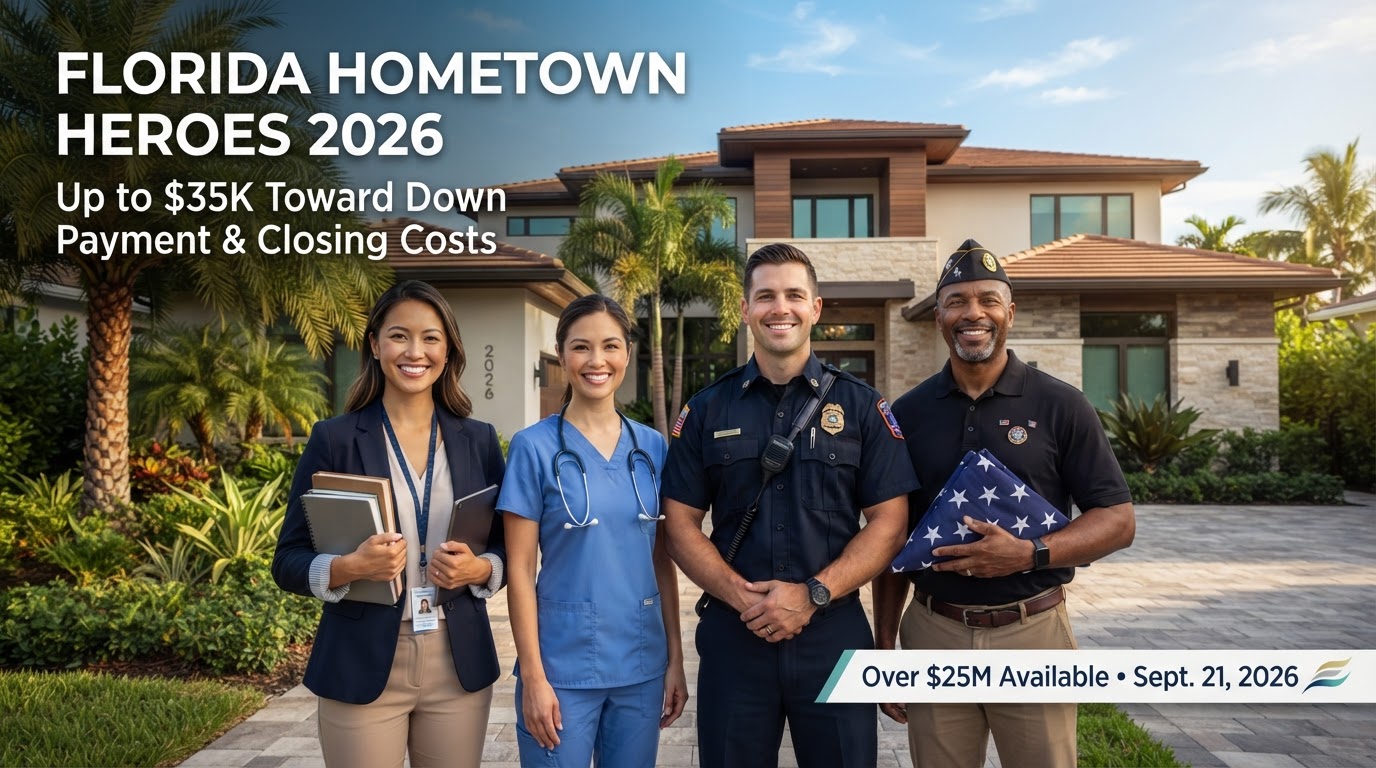
Florida's Hometown Heroes Housing Program is currently accepting eligible 2026 reservations, and the program administrator showed more than $25 million in down-payment assistance still available as of September 21, 2026. Eligible buyers may receive 5% of the first-mortgage amount, with a $10,000 minimum and $35,000 maximum, through a 0% deferred second mortgage.
The program is powerful, but the 2026 version has tighter occupational and work-location rules than many buyers remember from prior years.
What is Florida Hometown Heroes?
Florida Hometown Heroes is a state homebuyer program administered through the Florida Housing Finance Corporation. It pairs an eligible first mortgage with down-payment and closing-cost assistance for qualifying Florida workers, service members and veterans.
Under the current 2026 structure, the assistance equals 5% of the total first-mortgage loan amount, subject to a minimum of $10,000 and a maximum of $35,000. The second mortgage has a 0% interest rate, no monthly amortization and a 30-year deferred term.
That second mortgage is important to understand: It is not forgivable. The Hometown Heroes balance generally becomes due when the home is sold, the first mortgage is refinanced or paid off, the deed is transferred, or the borrower stops occupying the property as a primary residence.
Is Hometown Heroes funding still available in September 2026?
Yes, based on the latest program-administrator posting I found. As of September 21, 2026, eHousingPlus reported: "Over $25 Million Available in Hometown Heroes 2026 DPA."
That is worth paying attention to because prior Florida Hometown Heroes funding rounds have historically been committed quickly. Florida Housing reported that the previous 2025-2026 allocation was fully committed after helping more than 3,000 Florida households.
For a buyer, this means I would not build a purchase strategy around the assumption that funds will still be available months from now. Availability should be verified again when the buyer is actually ready to reserve the program.
Who qualifies for Hometown Heroes in 2026?
The 2026 program is no longer a general down-payment program for every full-time Florida worker. Florida Housing currently limits eligibility to qualifying workforce and military categories, including:
- healthcare workers;
- K-12 school staff;
- first responders;
- public-safety employees;
- qualifying court employees;
- childcare workers;
- eligible active-duty and reserve service members; and
- eligible veterans.
Only one qualifying occupying borrower generally needs to satisfy the eligible-employer requirement under the current TBA program guide. That can matter for married couples or co-borrowers when only one person's profession fits the program.
The September update makes work location especially important
This is one of the most useful 2026 rule changes for buyers and Realtors to understand. The current Hometown Heroes guides require eligible civilian borrowers to work full-time for a qualifying Florida-based employer with a physical Florida location and to work from or report to that location.
Fully remote workers
The current TBA guide specifically states that full-time remote employees are not eligible. So a nurse, teacher, healthcare employee or other qualifying professional does not automatically qualify simply because the employer is based in Florida if the borrower works entirely remotely under the program's definition.
Hybrid workers
Hybrid employees may qualify, but the guide was updated in August to require the employee to report to the eligible employer's physical location at least three days per week. That is a detail worth confirming before a Realtor structures an offer around the assumption that the buyer has $35,000 of assistance available.
What about self-employed or 1099 workers?
Florida Housing updated this area again on September 17, 2026. Under the current TBA guidance, a contracted 1099 borrower may qualify in certain circumstances if they work full-time for one qualifying employer and physically report to or work from a qualifying Florida brick-and-mortar location.
If the 1099 is issued to the borrower's business, either the borrower's business or the 1099 employer must maintain the qualifying Florida physical location under the program's rules. The guide also requires documentation supporting full-time self-employment rather than simply relying on the borrower's own statement.
This is a good example of why occupation alone doesn't determine Hometown Heroes eligibility. How and where you work can matter too.
What counts as a first-time homebuyer?
For the program, "first-time homebuyer" generally does not mean you have never owned a home in your life. The current guide defines a first-time buyer, subject to specified exceptions, as someone who has not had an ownership interest in a principal residence during the previous three years. Certain veterans and properties in federally designated targeted areas can have different treatment under the program.
That means someone who owned a primary home several years ago may potentially regain first-time-homebuyer status.
Hometown Heroes can pair with several mortgage types
The assistance is not a stand-alone second mortgage that you simply add to any loan. It must be used with an eligible Florida Housing first-mortgage program. The current program offers government and conventional options, including eligible:
- FHA
- VA
- USDA Rural Development
- Freddie Mac HFA Advantage
- and, through the applicable Bond structure, Fannie Mae HFA Preferred.
The correct structure depends on the borrower, property, income, loan type and program availability.
Why "Bond" versus "TBA" matters
This is one area most consumers will never see explained in a social-media post, but it can make a real difference. Hometown Heroes currently has Bond and TBA structures. The assistance amount can be similar, but the income and first-time-homebuyer tests are not identical.
Under the current Bond guide, income from adult household occupants can be considered for program eligibility, and first-time-homebuyer status can extend beyond just the occupying borrowers. Under the current TBA guide, program income generally focuses on borrowers on the loan rather than household income, and the first-time-homebuyer test applies to the occupying borrower or borrowers rather than a spouse who is not on the loan.
That means one Hometown Heroes structure may fit a household differently than another. From a practitioner's perspective, I would not reject a buyer based on one income-limit calculation until I know which Hometown Heroes execution is actually being evaluated.
South Florida 2026 Hometown Heroes income limits
For the current TBA Hometown Heroes option using FHA, VA or Freddie Mac HFA Advantage, the 2026 program guide shows the following income limits:
| County | 2026 TBA Income Limit | FHA Loan Limit | HFA Advantage / VA Loan Limit |
|---|---|---|---|
| Miami-Dade | $204,300 | $667,000 | $832,750 |
| Broward | $190,200 | $667,000 | $832,750 |
| Palm Beach | $192,750 | $667,000 | $832,750 |
These limits are from the current TBA program guide effective for qualifying reservations beginning May 6, 2026. USDA uses separate income limits, and the Bond program uses different household-size-based limits. Verify current eligibility before relying on these figures.
This distinction is important. Don't take one Hometown Heroes income number from a social post and assume it applies to every first-mortgage structure.
How much assistance would a buyer actually receive?
The formula is straightforward: 5% of the total first-mortgage loan amount, subject to a minimum of $10,000 and a maximum of $35,000.
For example:
- A $300,000 first mortgage could produce $15,000 of assistance.
- A $500,000 first mortgage could produce $25,000.
- A $700,000 first mortgage calculates to $35,000—reaching the program maximum.
These examples simply illustrate the formula and do not indicate loan approval, eligibility or cash required from the borrower.
Can Hometown Heroes pay both the down payment and closing costs?
Yes. The second-mortgage assistance may be applied toward eligible down-payment and closing-cost needs under the program. For some buyers, that can materially reduce the amount of cash required at closing. But it does not mean the borrower will necessarily close with no money of their own. The actual cash-to-close depends on the purchase price, loan program, closing costs, prepaid items, seller credits, earnest-money deposits, property taxes, insurance and the complete transaction.
Can the seller still give credits?
Potentially, yes, subject to the first-mortgage program's limits and underwriting requirements. This is where the strategy can become interesting. A buyer may be able to combine Hometown Heroes assistance with allowable seller credits so that one source addresses the down payment while the other helps with eligible closing costs or prepaid expenses. But I would not automatically ask for the maximum seller credit. The amount needs to be supported by actual allowable costs.
Is the Hometown Heroes rate always better?
No—and this is one of the most important points I would explain to a buyer. As of September 21, 2026, eHousingPlus showed different Hometown Heroes rates depending on whether the borrower used Bond or TBA financing and which first-mortgage program applied. For example, the published Hometown Heroes Bond FHA/USDA/VA rate was 6.75% on that date, while other program combinations were different.
For context, Freddie Mac's national average 30-year fixed rate was 6.95% as of September 17, 2026. Those numbers are not apples-to-apples loan quotes. Freddie Mac's survey represents a national conventional market sample, while Hometown Heroes has specific program requirements, DPA and rate structures.
The practical takeaway is: Do not choose Hometown Heroes only because someone says it has a "special rate." Compare the assistance, rate, mortgage insurance, fees, seller-credit strategy and repayable second mortgage against a standard loan.
The assistance can become due if you refinance
This is particularly important in the current mortgage market. The Hometown Heroes second mortgage is repayable when the first mortgage is refinanced. So if a buyer takes $25,000 of Hometown Heroes assistance today and later considers refinancing because market rates improve, the outstanding Hometown Heroes second mortgage generally has to be addressed at that time.
That doesn't make the program bad. It simply means the correct comparison isn't: "How much money do I get at closing?" It should be: "How does this financing strategy work today, and what happens if I sell or refinance later?" That is a much better mortgage conversation.
Do you need to be under contract to reserve Hometown Heroes funds?
Yes. The current program-administrator instructions state that lenders must have a fully executed purchase contract before locking/reserving the program loan. That creates an important planning issue. You generally want to determine that the buyer appears eligible before they start making offers—but the actual funds are reserved once the transaction reaches the required stage.
So the process is not: Reserve $35,000 today and shop for a house later. It is: Get qualified → understand the rules → shop → obtain an executed contract → confirm funding and reserve the program.
Why Realtors should understand the program before writing the offer
This matters for Realtors because Hometown Heroes affects more than the buyer's down payment. It can influence: financing type, required timeline, income eligibility, property eligibility, seller-credit strategy, closing-cost structure, and how confidently the financing contingency can be written.
The current program uses a 60-day reservation-to-purchase timeline, with a limited extension structure, so unusually long closings require additional planning. For new construction, the current guide also requires a Certificate of Occupancy before the program reservation can be made. Those are details that are much easier to solve before a contract is signed.
What I would check before telling a buyer they qualify
With Hometown Heroes, I would verify five things early:
- Occupation and employer — does the actual employer meet the current definition?
- Physical work location — remote, hybrid and brick-and-mortar rules can change eligibility.
- First-time-buyer status — including any applicable veteran or targeted-area exception.
- Income and household structure — especially when comparing Bond versus TBA.
- Loan and property fit — FHA, VA, USDA and conventional options can produce different numbers.
This is why a quick headline saying "Florida buyers get $35,000" is incomplete. Some buyers will qualify. Others will not. And for some who qualify, another financing structure may still make more sense.
Think you may qualify for Hometown Heroes?
Before you make an offer, let's verify your occupation, income, work location and first-time-buyer status, then compare Hometown Heroes with standard FHA, VA or conventional financing so you know the real cash-to-close and monthly payment. Let's check your eligibility →
Bottom line
Florida Hometown Heroes remains one of the most useful down-payment-assistance tools available to qualifying Florida buyers in 2026. And as of September 21, more than $25 million was still available.
But the program is more specific than many buyers realize. The 2026 rules focus on qualifying occupations, Florida-based physical work locations, first-time-buyer status, income limits and approved first-mortgage structures. Remote workers can face restrictions, hybrid employees now have a specific office-reporting standard, and recent September guidance added additional clarification for self-employed and 1099 borrowers.
For a buyer or Realtor, the best strategy is not: "Let's assume we have $35,000." It's: "Let's verify eligibility first, compare the Hometown Heroes structure against standard financing, and then make the offer with real numbers."
Program funding, interest rates, eligibility, income limits and loan terms can change without notice. Hometown Heroes assistance is subject to Florida Housing, participating-lender, agency, property and borrower requirements. This article is educational and does not constitute a commitment to lend, guarantee of program availability or guarantee of approval.
Frequently Asked Questions
How much does Florida Hometown Heroes provide in 2026?▾
The program provides 5% of the total first-mortgage amount, with a minimum assistance amount of $10,000 and a maximum of $35,000.
Is the $35,000 Hometown Heroes assistance free money?▾
No. The assistance is a 0%, non-amortizing, deferred second mortgage. It is not forgivable and generally becomes due upon sale, refinance, payoff of the first mortgage, transfer of deed or when the home is no longer the borrower's primary residence.
Is Florida Hometown Heroes still available right now?▾
As of September 21, 2026, eHousingPlus reported more than $25 million in 2026 Hometown Heroes down-payment-assistance funding still available. Funding can change as reservations are made.
Can remote workers use Hometown Heroes?▾
The current 2026 TBA guide says full-time remote workers are not eligible. Eligible hybrid employees must report to the physical employer location at least three days per week.
Can a veteran qualify?▾
Potentially. Current program rules include eligible veterans, although employment and first-time-homebuyer rules can differ depending on the structure used.
Can I use Hometown Heroes with FHA?▾
Yes. FHA is one of the eligible first-mortgage options, along with certain VA, USDA and conventional structures.
Do I have to be a first-time buyer?▾
Generally, yes, subject to specified veteran and targeted-area exceptions. The program's first-time-buyer definition generally looks for no ownership interest in a principal residence during the previous three years.
Do I need a purchase contract before funds are reserved?▾
Yes. Current eHousingPlus instructions require a fully executed purchase contract before the program loan is locked/reserved.
Authoritative Sources
- Florida Housing — Hometown Heroes Program
- eHousingPlus — Current Florida Housing Rates, Funding & Program Highlights
- Florida Housing / eHousingPlus — 2026 Hometown Heroes TBA Lender Guide, updated Sept. 17, 2026
- Florida Housing / eHousingPlus — 2026 Hometown Heroes Bond Lender Guide, updated Sept. 17, 2026
- Freddie Mac — Current Mortgage Rate Context
This is not a commitment to lend. All loans are subject to credit approval, property approval, program guidelines, and applicable terms. Programs, rates, terms, and conditions are subject to change without notice. Not all applicants will qualify. Equal Housing Opportunity.
Angel Taipale, NMLS #1736690 — Bright Horizon Lending Inc., NMLS #2565670. Verify on NMLS Consumer Access
More from First-Time Buyers
Mortgage Credit Scores Are Changing in 2026: What Florida Homebuyers Need to Know
Mortgage credit scoring is changing in 2026. Learn how VantageScore 4.0, FICO 10T and Classic FICO may affect Florida homebuyers and mortgage qualification.
ReadCan You Buy a Florida Home Before Starting a New Job? Fannie Mae's 2026 Offer-Letter Mortgage Rules
Some borrowers can qualify for a conventional mortgage using an accepted employment offer before their first paycheck. Learn Fannie Mae's October 2026 offer-letter rules, eligible start dates, reserve requirements and what Florida buyers should check.
Read