
First-Time Buyers
Mortgage Credit Scores Are Changing in 2026: What Florida Homebuyers Need to Know
Mortgage credit scoring is changing in 2026. Learn how VantageScore 4.0, FICO 10T and Classic FICO may affect Florida homebuyers and mortgage qualification.
Published August 31, 2026
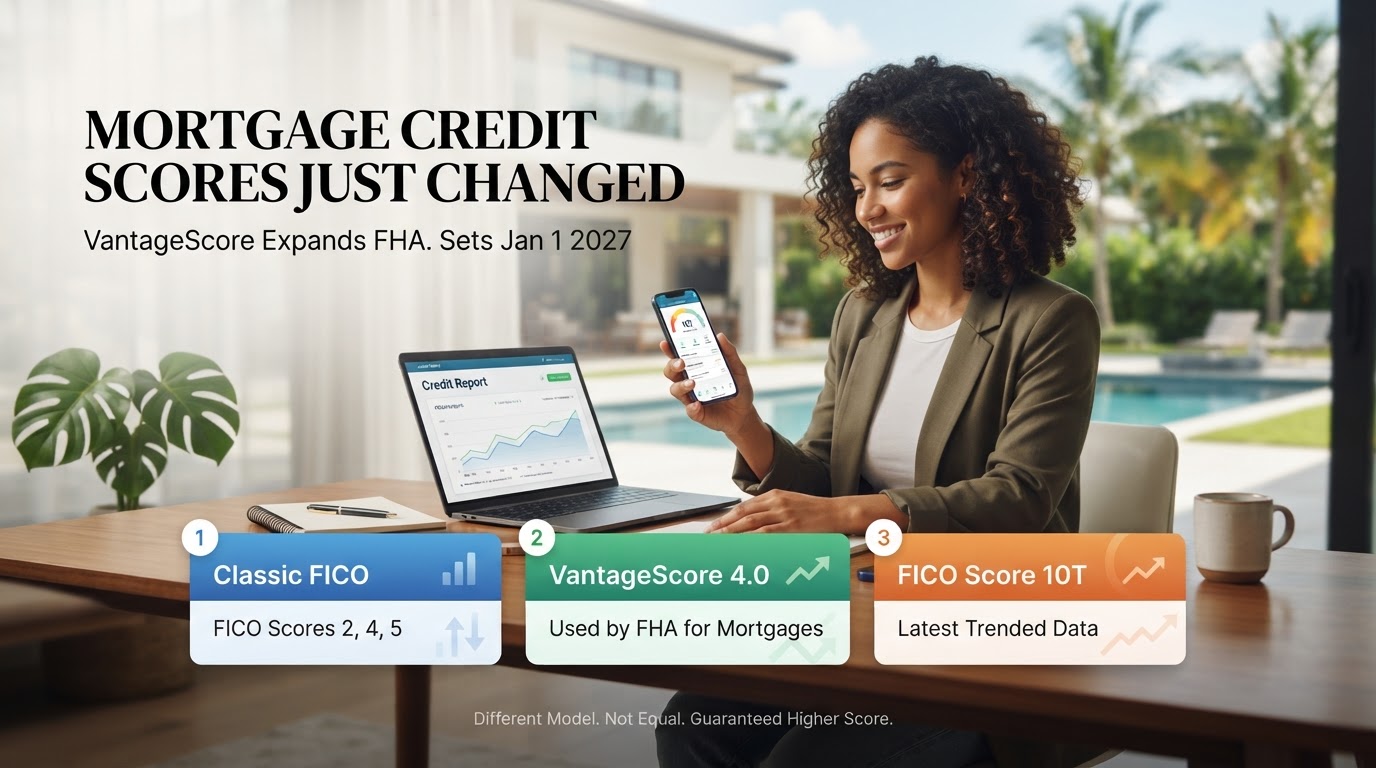
Mortgage lenders have historically relied heavily on Classic FICO scores, but that system is beginning to change. In 2026, Fannie Mae and Freddie Mac began allowing approved lenders to use VantageScore 4.0 for certain conventional loans, while FICO Score 10T is planned for future implementation. FHA has also announced adoption of these modern scoring models. This may eventually help lenders evaluate borrowers using a broader view of credit behavior.
Why mortgage credit scores are changing
For decades, borrowers applying for a conventional mortgage have generally been evaluated using versions of the Classic FICO credit-scoring model.
That model isn't disappearing overnight. But the mortgage industry is finally moving toward newer alternatives.
The Federal Housing Finance Agency, which oversees Fannie Mae and Freddie Mac, has approved three credit-scoring models for use within the evolving mortgage framework:
- Classic FICO
- VantageScore 4.0
- FICO Score 10T
FHFA says the goal is to introduce more competition, use more modern predictive models, and improve how mortgage credit risk is assessed.
For buyers, the practical takeaway is simple: The credit score you see in one consumer app may not be the same score a mortgage lender uses—and in the future, lenders may have more than one approved scoring model available.
Is VantageScore 4.0 being used for mortgages now?
Yes—but with an important qualification.
Fannie Mae and Freddie Mac began a limited rollout in 2026 that allows approved participating lenders to deliver certain mortgages using VantageScore 4.0 instead of Classic FICO. Not every lender is participating yet.
Fannie Mae's April 22, 2026 Selling Guide update made VantageScore 4.0 available immediately through that limited rollout, while FICO Score 10T is planned for a later implementation phase. Freddie Mac describes essentially the same framework: participating approved sellers can use VantageScore 4.0, while nonparticipating lenders continue using Classic FICO.
That means a buyer should not assume: "My VantageScore is higher, so every mortgage lender will qualify me using it." That is not how the transition works today. The lender, loan program and implementation status matter.
What is different about VantageScore 4.0?
VantageScore 4.0 is a newer credit-scoring model that can evaluate borrower behavior differently than Classic FICO.
One notable feature of newer scoring systems is the use of trended credit data. Instead of looking only at a snapshot of a credit account today, trended data can provide additional information about how debt has changed over time.
For example, two borrowers could each have a $5,000 credit-card balance today. But one borrower may have been steadily paying the balance down over the last year while another has been rapidly increasing debt. A newer scoring model may be able to distinguish those patterns more effectively.
FHFA also notes that newer approved scoring models can incorporate additional information such as rental-payment history when available.
What is FICO Score 10T?
FICO Score 10T is another newer credit-scoring model approved by FHFA. The "T" refers to its use of trended credit data.
Fannie Mae and Freddie Mac have already published historical FICO 10T data to help the mortgage industry evaluate how the newer model performs, but broad loan-delivery implementation is still expected at a later date. Fannie Mae published historical FICO 10T data covering loans acquired from approximately April 2013 through September 2025 on July 1, 2026.
So while FICO 10T is clearly part of the future mortgage framework, borrowers should not assume every lender is currently underwriting mortgages using it.
FHA is changing too
This modernization isn't limited to conventional loans.
On April 22, 2026, HUD announced that the Federal Housing Administration would permit VantageScore 4.0 and FICO Score 10T as eligible credit-scoring models for FHA-insured mortgage underwriting, in addition to Classic FICO. FHA followed that announcement in May by confirming its intention to enable the newer models within its mortgage-insurance framework.
That matters because FHA is often one of the first mortgage programs buyers explore when credit, down payment, or debt-to-income ratios make conventional financing more challenging. Again, implementation can vary by lender and system readiness, so the announcement does not mean that every FHA lender is already offering identical treatment under every scoring model.
Could this help borrowers with limited credit history?
Potentially. This is one of the reasons the modernization is important.
Traditional mortgage underwriting can sometimes be challenging for consumers who have responsible financial habits but limited traditional credit accounts. A borrower may:
- consistently pay rent on time;
- avoid carrying large credit-card balances;
- have only a few traditional credit accounts; or
- have relatively limited credit history.
Newer scoring models are intended to evaluate credit risk using more modern data and methodologies. FHFA specifically points to rental-payment history as one example of information newer models can use when available.
That does not mean that paying rent automatically creates mortgage eligibility. Credit score is only one part of underwriting. Income, assets, debts, property eligibility, down payment, reserves and the loan program itself still matter.
Will my VantageScore be higher than my FICO score?
Maybe—but not necessarily.
Consumers sometimes assume one model is always more generous than another. That isn't accurate. Different credit-scoring models can weight factors differently, so a particular borrower's VantageScore may be higher, lower or similar to a Classic FICO score.
That's why I generally advise buyers not to obsess over the exact number shown by a free consumer-credit app. The better question is: What score and credit profile will the lender actually use for the mortgage you're applying for?
Does this mean credit scores matter less?
No. Credit remains an important part of mortgage underwriting. The change is primarily about which approved scoring model can be used, not the elimination of credit analysis. Fannie Mae's current Selling Guide continues to require credit scores for most mortgages it purchases or securitizes.
A borrower with late payments, high revolving balances, collections or other credit problems shouldn't assume that changing score models will make those issues disappear. Modern scoring may evaluate those behaviors differently, but the underlying credit history still exists.
What should first-time homebuyers focus on instead?
This is the most useful part of the conversation. Rather than trying to game one specific scoring model, buyers should focus on the financial behaviors that generally support mortgage readiness.
Pay every account on time
Payment history remains one of the most important signals in virtually every major credit model. A missed payment shortly before applying for a mortgage can be significantly more damaging than many small optimization tactics.
Keep revolving balances under control
Credit-card utilization can influence credit scores. If possible, avoid running balances close to the limits immediately before applying for a mortgage.
Don't open unnecessary new credit
New accounts can create inquiries and alter the age and structure of your credit profile. That doesn't mean you can never open an account. It simply means you should discuss major credit changes with your mortgage professional while preparing to purchase a home.
Avoid closing old credit accounts without a reason
Closing a long-established revolving account can affect available credit and utilization. The right decision depends on the individual situation.
Review your credit before shopping seriously
Finding an error or unexpected account during a preapproval is much easier to address before you are under contract on a home.
What I'm seeing with Florida homebuyers
A common mistake I see is buyers trying to self-diagnose mortgage eligibility based entirely on the score displayed by a credit-card app. They may call me saying: "My score is 720, so I'm good." Or: "My score is only 640, so I probably can't buy." Neither conclusion tells us enough.
Mortgage qualification is based on the complete file. That includes the specific mortgage credit score being used, income and employment, monthly debts, available assets, down payment, property type, occupancy, loan program, and automated underwriting findings.
Credit-score modernization actually makes that consultation even more important because there may eventually be additional scoring-model options depending on the lender and program. If you're a first-time homebuyer, getting an actual mortgage preapproval is far more valuable than chasing a number on your phone.
What about mortgage rates right now?
Credit scoring is especially relevant in the current rate environment because a borrower's credit profile can affect available pricing and loan options.
Freddie Mac's latest weekly survey, released August 27, 2026, showed the national average 30-year fixed mortgage rate at 6.66%, compared with 6.65% the prior week. The average 15-year fixed rate was 5.98%. These are national survey averages, not quotes available to every borrower.
Actual mortgage pricing can depend on factors including credit profile, loan type, down payment, property type, loan amount, occupancy, points or lender credits, and market conditions when the rate is locked. That's another reason a borrower shouldn't use a generic advertised rate as a substitute for reviewing their actual scenario.
Could a new scoring model lower my mortgage rate?
Possibly indirectly, but there is no automatic rule saying a VantageScore 4.0 loan receives a lower mortgage rate. If a newer score changes how a lender evaluates a borrower's credit risk, it could potentially affect eligibility or pricing in some scenarios. But actual mortgage pricing still depends on the entire loan structure. A higher score under one model does not automatically guarantee a lower rate.
Does the lender get to choose the scoring model?
During the current interim rollout for Fannie Mae and Freddie Mac loans, participating lenders may choose which permitted credit-score model to use on a loan-by-loan basis. However, if VantageScore 4.0 is used, all borrowers on the loan must use the same scoring model.
That is an important technical point for mortgage professionals, but consumers mostly need to know that scoring-model availability can vary among lenders.
Why this matters for Realtors
Realtors should be careful about treating a buyer's consumer credit score as a definitive mortgage qualification. If your buyer says: "Credit Karma says I'm at 665." that alone doesn't tell you whether the buyer will receive an automated underwriting approval. Likewise, don't assume someone is disqualified because they report a lower consumer-facing score.
The right approach is still: Have the buyer complete an actual mortgage preapproval before relying on the credit number. As the industry introduces additional scoring models, that advice becomes even more important.
Bottom line
Mortgage credit scoring is entering one of its biggest changes in decades. Classic FICO is still very much part of the system, but VantageScore 4.0 is now being introduced for conventional mortgage lending through approved lenders, and FICO Score 10T is expected to follow later. FHA is moving toward the modernized models as well.
For Florida homebuyers, the takeaway isn't to chase a specific scoring model. It's to build a strong overall credit profile and get evaluated using an actual mortgage preapproval. The score displayed on your phone is useful information. It is not the entire mortgage decision.
Mortgage eligibility, credit-score requirements, pricing and loan terms vary by lender, investor, loan program and borrower profile. This article is educational and is not a commitment to lend or a guarantee of approval, pricing or specific loan terms.
Frequently Asked Questions
Is Fannie Mae using VantageScore 4.0 now?▾
Fannie Mae currently allows VantageScore 4.0 through a limited rollout with approved participating lenders. Other lenders continue using Classic FICO.
Is Freddie Mac using VantageScore 4.0?▾
Yes, through a similar limited implementation with approved participating sellers. Freddie Mac says nonparticipating lenders continue using Classic FICO.
Is FICO 10T being used for mortgages yet?▾
FICO Score 10T has been approved and is part of the industry's modernization plans, but Fannie Mae and Freddie Mac indicate broad implementation will occur at a later date.
Does FHA allow VantageScore?▾
HUD announced in April 2026 that FHA would permit VantageScore 4.0 and FICO Score 10T as eligible mortgage credit models alongside Classic FICO. Lender implementation and availability can vary.
Can rent payments help my mortgage credit score?▾
Newer scoring models can incorporate rental-payment information when available. However, rent history alone doesn't determine mortgage eligibility.
What credit score do I need to buy a house in Florida?▾
There is no single score that applies to every mortgage. Minimum requirements vary by loan program, lender, automated underwriting findings and the rest of the borrower profile.
Why is my mortgage score different from my credit app?▾
Consumer credit apps may use a different bureau, data set or scoring model than the one used for mortgage underwriting. A difference in scores is common.
Authoritative Sources
This is not a commitment to lend. All loans are subject to credit approval, property approval, program guidelines, and applicable terms. Programs, rates, terms, and conditions are subject to change without notice. Not all applicants will qualify. Equal Housing Opportunity.
Angel Taipale, NMLS #1736690 — Bright Horizon Lending Inc., NMLS #2565670. Verify on NMLS Consumer Access
More from First-Time Buyers
Florida Hometown Heroes 2026: Over $25 Million Still Available — Who Qualifies Now?
Florida Hometown Heroes 2026 still has more than $25 million available. See who qualifies, how the 5% assistance works, current South Florida limits, and important September rule updates.
ReadCan You Buy a Florida Home Before Starting a New Job? Fannie Mae's 2026 Offer-Letter Mortgage Rules
Some borrowers can qualify for a conventional mortgage using an accepted employment offer before their first paycheck. Learn Fannie Mae's October 2026 offer-letter rules, eligible start dates, reserve requirements and what Florida buyers should check.
Read