
VA/FHA/Conventional
VA Loan Assumptions in Florida: Can You Take Over a Seller's Low Mortgage Rate?
VA mortgages are assumable when the buyer qualifies. Learn how VA loan assumptions work in Florida, who can assume one, the equity-gap issue, seller entitlement risks, fees, and timelines.
Published September 24, 2026
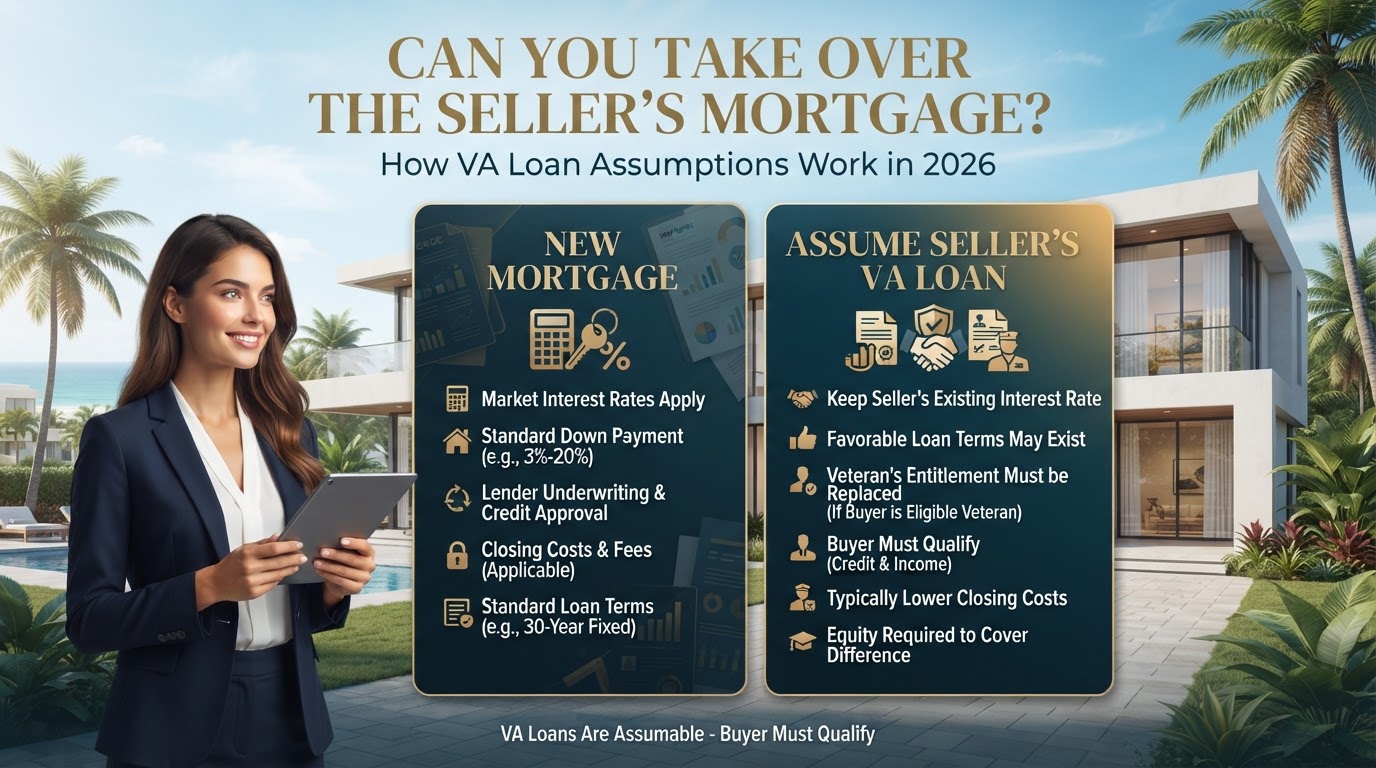
Yes. VA-guaranteed mortgages are assumable, meaning a qualified buyer may take over the seller's existing VA mortgage instead of obtaining an entirely new first mortgage. The buyer does not necessarily need to be a Veteran, but the transaction requires approval and underwriting. The biggest issues are usually the seller's remaining loan balance, the buyer's equity gap, and whether the seller's VA entitlement will be restored.
Why VA assumptions are especially interesting right now
Freddie Mac reported on September 24, 2026 that the national average 30-year fixed mortgage rate reached 7.03%, up from 6.95% the previous week. A year earlier, the comparable Freddie Mac average was 6.30%.
Those figures are national conventional-market averages — not individual VA loan quotes. But the current environment highlights why an older assumable mortgage can be valuable.
Consider a hypothetical example. A home has a VA mortgage with a remaining balance of $400,000 and an existing rate of 3.25% over 27 remaining years. Principal and interest on that remaining loan is approximately $1,856 per month. For comparison, financing $400,000 over a new 30-year mortgage at 7.03% would produce principal and interest of approximately $2,669 per month — a difference of about $813 per month.
That does not mean the buyer automatically saves $813 or that 7.03% represents an available VA rate. Taxes, insurance, funding fees, the purchase price, remaining loan term, buyer qualification, transaction costs and especially the seller's equity all matter. But it demonstrates why an assumption deserves analysis.
What is a VA loan assumption?
A mortgage assumption means the buyer takes over an existing mortgage instead of paying that mortgage off and replacing it with an entirely new loan. VA specifically confirms that VA-guaranteed loans are assumable as long as the person assuming the loan qualifies.
That creates a potentially valuable opportunity when the seller's existing mortgage has terms that are significantly better than current market financing. For example, imagine a seller obtained a VA mortgage several years ago with a fixed rate in the low 3% range. Instead of the buyer obtaining a brand-new mortgage at today's market pricing, the buyer may be able to assume the existing interest rate, the existing unpaid principal balance, the remaining amortization term, and the existing VA-guaranteed loan obligation — subject to approval of the assumption.
The buyer is not receiving a brand-new VA mortgage at the old interest rate. They are taking over the existing loan. That distinction matters.
Does the buyer have to be a Veteran?
No. This is one of the biggest misconceptions about VA assumptions. The VA Buyer's Guide states that anyone — including a non-Veteran — may assume a VA loan if they qualify. That means a potential buyer could be a Veteran, an active-duty service member, another VA-eligible borrower, or a civilian with no VA entitlement.
But there is an important catch for the seller. Whether the buyer has VA entitlement can determine what happens to the seller's VA entitlement after closing.
The seller's entitlement is the part everyone needs to understand
A VA loan assumption can accomplish two different things: release the seller from liability, and restore the seller's VA entitlement. Those are not the same thing.
VA's assumption guidance explains that when an assumption occurs without substitution of entitlement, the original Veteran's entitlement remains tied to the loan until that loan is paid in full. The seller may be released from personal liability through the properly approved assumption, but the VA entitlement originally used to guarantee the mortgage can remain encumbered.
That can affect the Veteran seller's ability to use their VA benefit for another home. This is why sellers should not treat the question as simply: "Will the buyer take over my mortgage?" The better question is: "Will I receive both a release of liability and restoration of my VA entitlement?"
What is substitution of entitlement?
If the buyer is an eligible Veteran with sufficient available entitlement, the buyer may agree to substitute their VA entitlement for the seller's. VA explains that if a qualified Veteran transferee assumes the mortgage and substitutes sufficient entitlement, the original Veteran seller may have their entitlement restored.
For substitution of entitlement, the assuming Veteran must have sufficient entitlement and satisfy the applicable VA requirements. This is often the cleanest assumption scenario for a VA seller who plans to use the VA benefit again.
- Buyer is an eligible Veteran with sufficient entitlement: Buyer assumes mortgage → buyer's entitlement substitutes → seller's entitlement can be restored.
- Buyer is not VA eligible: The buyer may still qualify to assume the loan. But the seller's original entitlement generally remains tied to the mortgage until the loan is eventually paid off.
That distinction needs to be discussed before the purchase contract is structured.
The biggest challenge: the equity gap
The interest rate usually gets all the attention. But the equity gap is often the real obstacle.
Suppose a South Florida property sells for $600,000 and the seller's assumable VA mortgage balance is $400,000. The assumption only transfers approximately the existing $400,000 mortgage balance. It does not magically increase that old VA loan to $600,000. That leaves approximately $200,000 of seller equity that has to be addressed in the transaction.
The VA Buyer's Guide notes that the seller and buyer may negotiate how the seller's equity is paid as part of the sale. Depending on the transaction, that could require substantial buyer cash or another permitted financing arrangement.
That is why a fantastic 3% mortgage does not automatically make an assumption practical. The first calculation I would run is:
Purchase price − Assumable loan balance = Approximate equity gap
Then we determine whether the buyer can realistically solve that gap.
A better assumption example
Imagine a purchase price of $475,000 with a VA loan balance of $420,000 — an approximate equity gap of $55,000. Now the assumption becomes much more interesting. Compare that with a purchase price of $700,000 and a VA loan balance of $350,000 — an approximate gap of $350,000. Even though both sellers might have the same attractive mortgage rate, the second transaction may be far more difficult for the buyer to structure.
So Realtors searching for assumable loans should not stop at: "Seller has a 3% VA mortgage." Ask: "What is the approximate remaining balance?" That number can be just as important as the interest rate.
Does the buyer still have to qualify?
Yes. A VA assumption is not simply a transfer of the payment to whoever buys the property. VA's current assumption guidance states that the loan generally must be current, the purchaser must be contractually obligated to purchase the property and assume full liability, and the assuming buyer must be creditworthy under applicable VA underwriting standards.
The current holder or servicer typically evaluates the assumption application. That commonly includes reviewing credit, income, debts, financial capacity, assumption documentation, and the complete purchase transaction. The fact that the original borrower qualified for the mortgage years ago does not eliminate underwriting for the new purchaser.
Who approves the assumption?
Usually the existing mortgage servicer plays the central role. VA states that holders or servicers with automatic authority process and decide assumption applications for loans they hold or service. Under VA Circular 26-23-10, the authorized servicer is generally required to make a decision within 45 calendar days after receiving a complete assumption application package.
If neither the holder nor its authorized servicing agent has automatic authority, the package must be sent to VA for prior approval under the applicable process. That is an important Realtor timeline issue. A VA assumption should not be written into a purchase contract as though it will close on the same timeline as every conventional loan. The parties should identify the servicer early and understand that a complete assumption application is what starts the applicable processing clock.
Can the servicer simply refuse to allow assumptions?
VA describes assumptions as a fundamental feature of VA-guaranteed loans. Its formal assumption training guidance states that it is not an option simply to refuse to offer the assumption process on an otherwise assumable VA-guaranteed loan. That does not mean the assumption must be approved — the buyer still has to qualify and the transaction must satisfy the applicable VA requirements. But "we don't do assumptions" is different from: "The buyer applied and did not satisfy the requirements."
How much does a VA loan assumption cost?
VA assumptions can have fees, but their structure differs from originating an entirely new mortgage. VA's Buyer's Guide lists the loan assumption funding fee at 0.5%, unless an exemption applies. Certain borrowers can be exempt from VA funding fees based on VA rules.
VA Circular 26-23-10 also states that the holder or servicer may charge an assumption processing fee of up to $300 when the assumption is processed under automatic authority or $250 when VA prior approval is required under that guidance. Other allowable transaction charges can still apply, including credit reporting, recording, taxes, insurance and title-related costs when applicable.
That is another reason an assumption should be reviewed using an actual closing-cost worksheet rather than marketed as: "Just take over the mortgage for free." It isn't that simple.
Does assuming a VA loan mean zero down?
Not necessarily. This is another common misunderstanding. A new VA purchase mortgage can sometimes allow an eligible Veteran to purchase without a down payment, subject to entitlement, appraisal and loan requirements. A VA assumption is different. The buyer is taking over the existing loan balance. If the seller has equity above that balance, the buyer still has to deal with that equity gap.
For example, a purchase price of $600,000 with an assumed balance of $500,000 leaves a potential gap of $100,000. Even if the underlying VA loan originally required no down payment, that does not make the $100,000 seller equity disappear.
What if the buyer is also a Veteran?
This can create one of the most attractive assumption structures. If the buyer is VA eligible, has sufficient available entitlement, qualifies for the assumption, and satisfies the applicable substitution requirements, the buyer may substitute their entitlement for the seller's. That can allow the seller's VA entitlement to be restored while the buyer assumes the existing mortgage. For a Veteran-to-Veteran transaction, I would investigate this possibility very early.
What if the buyer is not a Veteran?
The transaction can still potentially work. VA explicitly states that a non-Veteran may assume a VA loan if qualified. But because a non-Veteran does not have VA entitlement to substitute, the original Veteran seller's entitlement can remain tied to the assumed loan. For some sellers, that is acceptable. For others — especially a Veteran planning to immediately buy another property with VA financing — it can be a major problem. This is why the seller should understand the entitlement consequences before accepting the offer.
Release of liability vs. restoration of entitlement
These two terms deserve their own explanation.
- Release of liability — The seller is released from personal responsibility for repayment after the properly approved assumption.
- Restoration of entitlement — The portion of VA entitlement tied to the existing mortgage becomes available again to the Veteran.
A seller may receive a release from liability without having their entitlement restored when the assumption is completed without substitution of entitlement. That difference is one of the most important details in the entire transaction.
Can the seller still buy another home with a VA loan?
Potentially. Even if some entitlement remains tied to the assumed mortgage, the seller could still have remaining entitlement available. VA explains that Veterans who have previously used and not restored entitlement may still be able to obtain another VA-backed mortgage using remaining entitlement, with the applicable county-loan-limit calculation determining how much guaranty remains available. That calculation is borrower-specific.
So a seller should not automatically assume: "My entitlement is tied up, so I can't buy again." But they also should not assume: "The assumption automatically restored all my entitlement." Get the Certificate of Eligibility reviewed.
Why this could matter in South Florida
From a financing standpoint, I think assumable mortgages should become part of the conversation when a buyer is comparing properties in Miami-Dade, Broward or Palm Beach. If I were reviewing two otherwise similar properties and one seller had a substantially below-market assumable VA mortgage, I would want to know:
- What is the current loan balance?
- What is the existing interest rate?
- How many years remain?
- What is the purchase price?
- How large is the equity gap?
- Is the buyer a Veteran with entitlement?
- Who is the current servicer?
Those pieces of information can tell us very quickly whether the assumption deserves deeper analysis. It is not automatically the best structure. But ignoring it could mean overlooking one of the most valuable features attached to the property.
Realtors: don't market only the interest rate
An assumable mortgage can absolutely make a listing more compelling. But advertising: "2.75% assumable VA loan!" without the rest of the information can create confusion. A more useful Realtor conversation includes the approximate remaining balance, remaining term, a note that the assumption is subject to buyer qualification, the estimated seller equity gap, whether substitution of entitlement may be available, and servicer processing considerations. This lets buyers evaluate the real transaction, not just the headline rate.
Assumption vs. getting a new mortgage
A lower assumed rate doesn't automatically make the assumption the best financing choice. I would compare the VA assumption (existing balance, existing rate, remaining term, equity gap, assumption costs, processing timeline, seller entitlement consequences) versus a new mortgage (full purchase-price financing structure, current interest rate, down payment, seller concessions, closing costs, available loan program, future flexibility).
A buyer with $150,000 available to cover an equity gap might strongly prefer the assumption. Another buyer may need financing for almost the entire purchase price and find that a new VA, FHA or conventional mortgage works better despite the higher rate. The property and borrower have to be analyzed together.
Found a Florida home with an assumable VA mortgage?
Before you structure the offer, let's review the seller's current balance, rate, remaining term, equity gap and entitlement situation so you can compare the assumption against a new VA or conventional mortgage using real numbers. Let's review your scenario →
Bottom line
VA assumptions may be one of the most overlooked financing opportunities in a higher-rate mortgage market. With Freddie Mac's national 30-year average at 7.03% on September 24, 2026, an existing VA mortgage carrying a substantially lower fixed rate can have real economic value.
But the interest rate is only half the story. The buyer needs to understand the remaining loan balance and seller equity gap. The seller needs to understand the difference between release of liability and restoration of VA entitlement. And both parties need to understand that the buyer must qualify and the existing servicer must approve the assumption.
For Florida buyers and Realtors, my approach would be: If a property has an existing VA mortgage, don't automatically assume the financing has to be paid off. Find out whether the existing loan itself is part of the opportunity.
VA loan assumptions, entitlement restoration, qualification, costs, timelines and transaction requirements are subject to VA rules, servicer requirements, borrower qualification and the specific existing mortgage. Market-rate figures are national survey averages and are not individual loan quotes. This article is educational and does not constitute a commitment to lend, guarantee of approval, legal advice or guarantee that an assumption will be completed.
Frequently Asked Questions
Are VA loans assumable?▾
Yes. VA states that VA-guaranteed loans are assumable when the person taking over the mortgage qualifies.
Does the buyer have to be a Veteran?▾
No. VA guidance says anyone, including a non-Veteran, can potentially assume a VA mortgage if qualified. However, a non-Veteran cannot substitute VA entitlement for the original Veteran seller.
Does the buyer get the seller's interest rate?▾
The assumption takes over the existing mortgage obligation, including its existing rate and remaining term, subject to the approved transaction.
Does a VA assumption mean no down payment?▾
Not necessarily. The buyer assumes only the existing mortgage balance. If the sale price exceeds that balance, the seller's equity gap must still be addressed.
What happens to the seller's VA entitlement?▾
If a qualified Veteran buyer substitutes sufficient VA entitlement, the seller's entitlement may be restored. Without substitution of entitlement, the original seller's entitlement generally remains tied to the loan until it is paid off.
Is release of liability the same as restoration of entitlement?▾
No. The seller can potentially be released from liability while the original VA entitlement remains encumbered by the assumed loan.
How long does a VA assumption take?▾
For servicers with automatic authority, current VA guidance generally requires a decision within 45 calendar days after receipt of a complete assumption application package. Other situations can involve VA prior approval.
Is there a VA funding fee on an assumption?▾
VA's published funding-fee table lists a 0.5% loan-assumption funding fee, subject to applicable exemptions.
Can I assume a VA loan if I already own another home?▾
The answer depends on the buyer, assumption underwriting and whether VA entitlement/substitution is involved. The assumption should be reviewed with the servicer and mortgage professional rather than relying on a general rule.
Authoritative Sources
- U.S. Department of Veterans Affairs — VA Purchase & Cash-Out Loans / Assumability
- VA Buyer's Guide — Loan Assumptions & Funding Fees
- VA Circular 26-23-10 — Assumption Procedures, Entitlement & Fees
- VA — Certificate of Eligibility & Restoration of Entitlement
- VA — Remaining Entitlement and Loan Limits
- Freddie Mac — Mortgage Rates, September 24, 2026
This is not a commitment to lend. All loans are subject to credit approval, property approval, program guidelines, and applicable terms. Programs, rates, terms, and conditions are subject to change without notice. Not all applicants will qualify. Equal Housing Opportunity.
Angel Taipale, NMLS #1736690 — Bright Horizon Lending Inc., NMLS #2565670. Verify on NMLS Consumer Access