VA/FHA/Conventional
FHA 203(h) Disaster Loans in Florida: Can Hurricane Victims Buy With No Down Payment?
Lost your Florida home to a hurricane? Learn how FHA 203(h) disaster loans offer eligible buyers 100% financing, including renters and Hurricane Isaias survivors.
Published November 2, 2026
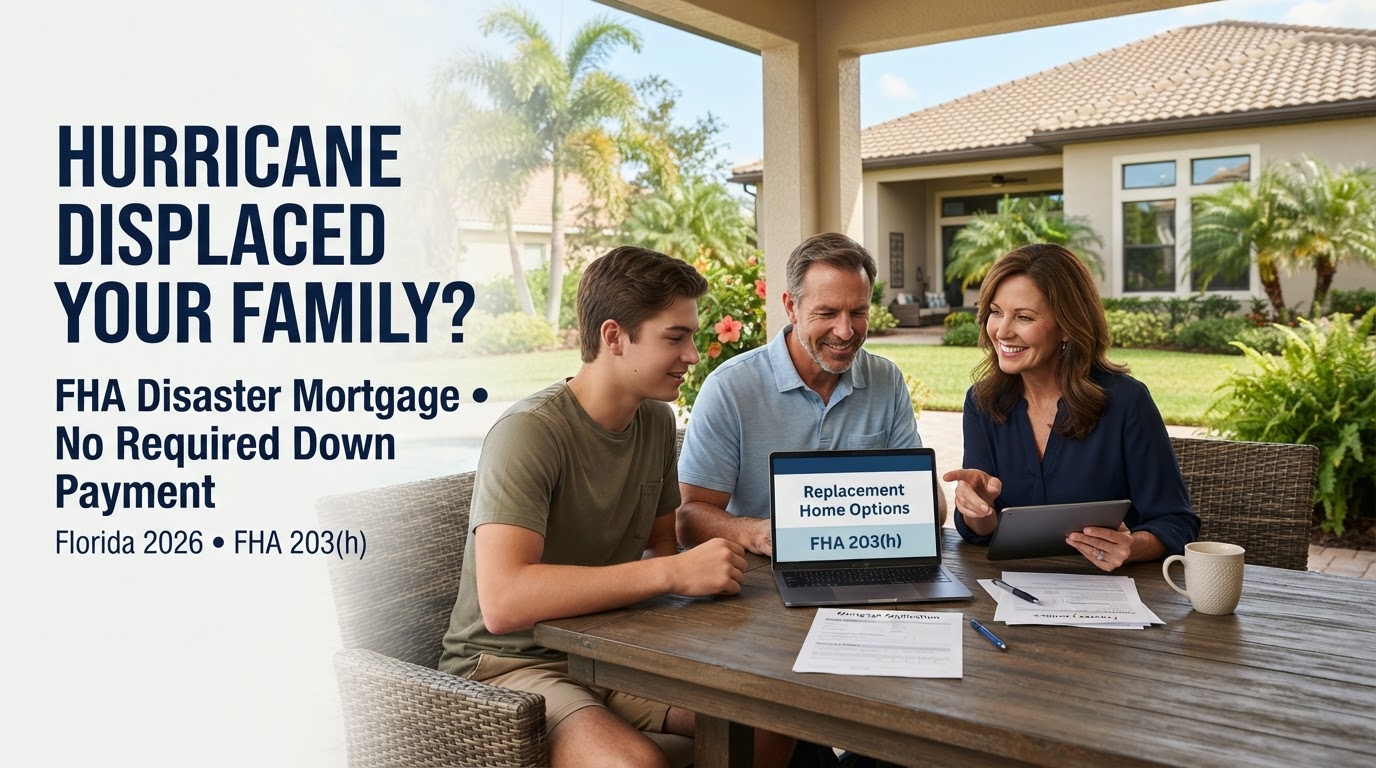
Yes. Florida homeowners and renters whose previous residence was destroyed or severely damaged in a qualifying presidentially declared major disaster may be eligible for an FHA 203(h) mortgage with no required down payment. The program allows up to 100% financing for an eligible replacement primary residence. However, borrowers must satisfy FHA underwriting requirements, document disaster eligibility, and address closing costs and mortgage insurance.
Following Hurricane Isaias and the October 2026 federal disaster declarations, this program deserves attention from affected Florida households. But the most important distinction is this: a federal disaster declaration does not automatically mean every resident qualifies for an FHA 203(h) mortgage. The borrower, prior residence, disaster designation and replacement property must meet the program's requirements. Start with our Florida FHA and conventional mortgage resources hub, then let's break down the rules.
What is an FHA 203(h) disaster loan?
FHA Section 203(h) is a federal mortgage-insurance program designed for people who have lost their housing because of a major disaster. The program allows FHA-approved lenders to make mortgages to eligible disaster victims who need to purchase or reconstruct a principal residence.
Unlike a standard FHA purchase loan, an eligible 203(h) purchase can provide 100% financing without a required down payment. HUD specifically identifies this as a program that helps displaced households reestablish permanent housing. However, the mortgage is still a loan made through an FHA-approved lender. It is not a FEMA grant. It is not free money. The borrower remains responsible for the mortgage and must qualify under applicable FHA requirements.
What happened in Florida in October 2026?
Hurricane Isaias affected Northwest Florida during October 6–12, 2026. On October 27, 2026, a federal major disaster declaration was approved for Florida under disaster number DR-4955-FL. The initial declaration authorized Public Assistance in 15 counties.
On October 29, FEMA announced additional assistance for individuals in eight counties:
- Bay County.
- Escambia County.
- Gulf County.
- Holmes County.
- Okaloosa County.
- Santa Rosa County.
- Walton County.
- Washington County.
This distinction is important. Public Assistance generally supports eligible governments and public recovery work. Individual Assistance addresses eligible household recovery needs. Disaster designations and available assistance programs can change as FEMA updates a declaration. For a mortgage application, the lender must verify the actual presidential disaster designation and applicable FHA eligibility requirements.
The October 2026 declaration does not mean all Florida counties automatically qualify. Miami-Dade, Broward and Palm Beach are not included in the eight counties identified in the October 29 individual-assistance announcement. However, a qualifying displaced household may be able to purchase its replacement home elsewhere in Florida.
Hurricane Isaias — Florida disaster timeline
- October 6–12, 2026: Hurricane disaster incident period.
- October 27, 2026: Federal major disaster declaration (DR-4955-FL).
- October 29, 2026: Individual assistance announced for eight Florida counties.
- One-year application window: Confirm the applicable FHA 203(h) deadline with your lender.
County designations and assistance programs must be verified using current FEMA records.
Can hurricane victims buy a home with no down payment?
Potentially, yes. HUD states that qualifying FHA 203(h) borrowers may obtain financing up to 100% of the eligible property's value. For example, imagine a Florida household needs to replace a home that was destroyed by a qualifying hurricane. The family identifies an eligible replacement property with a purchase price of $350,000. Assume the approved mortgage amount, valuation and FHA loan limit support a $350,000 base mortgage. Under an eligible FHA 203(h) transaction, the borrower may not need to make a traditional down payment.
But that does not mean the transaction is free. The borrower must still account for closing costs, prepaid homeowners insurance, property taxes, escrow funding, applicable mortgage insurance, and other required settlement expenses. The lender must calculate the actual cash needed for closing. The example is illustrative and does not represent an approval or guaranteed loan amount.
100% financing does not mean zero cost
Replacement home
$350,000
Potential eligible base mortgage
$350,000
Required down payment
$0
Closing costs & mortgage insurance
Must be addressed separately
Illustrative only. Subject to FHA limits, property value, underwriting and lender approval.
Does FHA 203(h) cover closing costs?
Not automatically. This is an important distinction. HUD permits 100% financing for an eligible 203(h) purchase, but closing costs and prepaid expenses generally need to be covered through permitted sources. HUD identifies options that may include borrower funds, permitted premium pricing or lender credits, and eligible seller contributions. Applicable seller contributions remain subject to FHA requirements, including the relevant 6% limitation.
An approved loan with no required down payment may still have cash-to-close expenses. The correct strategy is to obtain an itemized Loan Estimate and review the total transaction.
Can renters qualify for FHA 203(h)?
Yes, potentially. This is one of the most overlooked features of the program. HUD specifically states that people who rented their previous residence may be eligible. A renter does not need to have owned a home before the disaster.
For example, consider a family renting a house in a designated disaster area. The rented residence sustains damage severe enough that reconstruction or replacement is necessary. If the household meets the applicable FHA 203(h) requirements, the family may be able to use the program to purchase a replacement primary residence. That means the program may serve both displaced homeowners and renters. However, the lender must still document the prior residence, qualifying disaster-related damage and the borrower's mortgage eligibility. A renter does not automatically qualify simply because they lived in a county included in a disaster declaration.
Who may qualify for FHA 203(h)?
- 1. Previous residence in an eligible declared disaster area.
- 2. Home destroyed or damaged enough that replacement or reconstruction is necessary.
- 3. Borrower and replacement property satisfy FHA eligibility and underwriting.
Both eligible former homeowners and renters may qualify. A disaster declaration alone does not establish mortgage eligibility.
Displaced by a Florida hurricane?
If your previous residence was destroyed or severely damaged in a qualifying disaster, you may have mortgage options that are different from a standard home purchase. Let's review your disaster eligibility, existing housing obligations and available replacement-home financing before you commit to another property.
How severe must the damage be?
The prior home must have been destroyed or damaged to an extent that reconstruction or replacement is necessary. Minor repairs or ordinary cosmetic storm damage are not the same as losing a usable residence. The lender may need supporting documentation establishing the location of the previous residence, occupancy before the disaster, the applicable disaster event, the extent of the damage, and whether replacement or reconstruction is necessary. Documentation may involve insurance records, local government information, inspection reports or other evidence acceptable to the lender. The exact documentation should be determined by the FHA-approved lender handling the transaction.
Can you buy a replacement home outside the disaster area?
Yes. HUD's consumer guidance specifically explains that the replacement home does not have to be located in the presidentially declared disaster area. An eligible disaster victim may purchase a replacement home elsewhere in the United States. That distinction matters for Florida families considering relocation.
For example, a qualifying household displaced in Northwest Florida might decide to purchase a replacement primary residence in Jacksonville, Orlando, Tampa, Miami-Dade County, Broward County, Palm Beach County, or another eligible location. The borrower's previous residence must satisfy the applicable disaster eligibility requirements. The replacement property must satisfy FHA property and occupancy requirements. Buying outside the disaster area does not waive the normal mortgage qualification process.
What is the deadline for an FHA 203(h) application?
HUD states that borrowers generally must apply for an FHA 203(h) mortgage through an FHA-approved lender within 12 months of the presidential disaster declaration. For the Florida Hurricane Isaias major disaster declaration dated October 27, 2026, the corresponding one-year anniversary is October 27, 2027. Borrowers should confirm the controlling FHA application deadline with their lender, including whether any applicable extension or case-specific guidance changes the calculation.
Do not confuse this with the deadline to apply for FEMA Individual Assistance. FEMA assistance deadlines and FHA mortgage deadlines serve different purposes. The safest approach is to begin the mortgage review early rather than wait until the final weeks of the application window.
Do you have to be approved for FEMA assistance first?
FEMA disaster assistance and FHA 203(h) mortgage qualification are separate processes. Receiving FEMA assistance does not automatically qualify someone for an FHA mortgage. Likewise, the lender must apply HUD's specific disaster and borrower eligibility requirements rather than treating a FEMA payment as the sole qualification test. What matters is whether the borrower meets the applicable 203(h) requirements, including the qualifying previous residence, disaster-related damage and mortgage underwriting. Borrowers should separately follow FEMA's instructions for available disaster relief.
Is FHA mortgage insurance required?
Yes. FHA 203(h) financing is still FHA-insured financing. HUD states that qualifying borrowers must pay applicable upfront and annual mortgage insurance premiums. The upfront mortgage insurance premium may be financed when permitted. The recurring mortgage insurance premium generally contributes to the monthly mortgage expense. The borrower must also budget for applicable property taxes, homeowners insurance and other housing expenses. No required down payment should not be confused with no monthly borrowing cost.
What credit score and income do you need?
FHA 203(h) does not eliminate the mortgage underwriting process. Borrowers must satisfy applicable FHA and lender requirements involving credit, qualifying income, employment, debt obligations, residency eligibility, property condition, mortgage limits, and ability to repay. Certain disaster-related circumstances may require additional documentation or individual underwriting review. Actual lender requirements can vary. It would be misleading to tell every disaster survivor that the program guarantees approval regardless of credit or income. An FHA-approved lender must evaluate the full application.
What if you still owe a mortgage on the damaged home?
This can complicate the financing. A disaster does not automatically eliminate an existing mortgage balance. If a homeowner has an outstanding mortgage on the damaged property, that obligation must be addressed with the loan servicer and evaluated in the new mortgage application. The homeowner may also have insurance proceeds, a pending insurance claim, disaster assistance, property-sale proceeds, or other financial obligations associated with the damaged property. These circumstances can affect the borrower's overall financial picture.
I would recommend contacting the existing mortgage servicer immediately to discuss available disaster-related assistance and repayment options. The new FHA 203(h) loan should not be treated as automatically paying off the old mortgage.
What is the difference between FHA 203(h) and FHA 203(k)?
These are two different FHA programs.
FHA 203(h)
Designed for qualifying victims of major disasters who need to purchase or reconstruct a principal residence. A key benefit is the possibility of 100% financing without a required down payment.
FHA 203(k)
Designed to finance eligible rehabilitation or renovation costs in connection with a purchase or refinance. It is not limited to disaster victims. For a deeper comparison, read our guide to FHA 203(k) renovation loan options.
HUD also explains that an eligible FHA 203(h) mortgage may be combined with FHA 203(k) rehabilitation financing when the applicable requirements are satisfied. For example, a qualifying disaster survivor may find a replacement home that also needs eligible improvements. Depending on the property, approved rehabilitation financing may be incorporated into the transaction. But the borrower must meet the requirements of both applicable programs. The two programs should not be confused.
What about 2026 FHA loan limits?
FHA 203(h) financing remains subject to applicable FHA mortgage limits. The limits vary according to the property's location and, when relevant, property characteristics. For 2026, HUD lists a national one-unit FHA loan-limit floor of $541,287 and a high-cost-area ceiling of $1,249,125. These are national boundaries, not a statement that every Florida county permits the same FHA mortgage amount. The lender must verify the actual FHA loan limit for the replacement property's county and transaction. The disaster-victim program does not waive applicable loan limits.
What about mortgage rates in November 2026?
Freddie Mac's most recent weekly survey available as of November 3, 2026 was published October 29. It reported a 30-year fixed national average of 7.24% and a 15-year fixed national average of 6.60%. The 30-year average declined from 7.32% the previous week. These figures represent national conventional conforming mortgage survey averages. They are not FHA 203(h) interest rates. An individual's mortgage rate depends on the lender, loan program, property, borrower qualifications, market conditions and lock timing. For a displaced household, the first priority should be determining eligibility and calculating the full cost of replacement housing.
My approach to FHA disaster-recovery financing
When someone tells me, "Angel, our home was destroyed by the hurricane. Can we buy another home without a down payment?" I would begin by verifying the disaster eligibility. First, determine where the family was living when the event occurred. Second, confirm the relevant presidential disaster declaration and applicable geographic designation. Third, document the damage and why reconstruction or replacement is necessary.
Then review the borrower's credit, income, existing debts, available assets and proposed replacement property. If the borrower still owes a mortgage on the damaged residence, I would also want to understand the status of that loan and any insurance claims. After that, compare eligible FHA 203(h) financing with other available mortgage options, including standard FHA mortgage options in Florida and the broader Florida first-time homebuyer resources. The goal is to identify a realistic path to replacement housing—not simply advertise a zero-down loan without reviewing the complete situation.
The bottom line
FHA 203(h) is a valuable but frequently overlooked mortgage option for qualifying disaster victims. Following Hurricane Isaias and Florida's October 2026 disaster declarations, affected homeowners and renters should understand that eligible replacement-home financing may be available without a required down payment. However, the disaster declaration alone does not guarantee mortgage eligibility. The previous residence must meet the applicable disaster-damage requirements, the borrower must qualify, and closing costs and mortgage insurance must still be addressed. A qualifying borrower may also purchase a replacement home outside the original disaster area.
If you were displaced by a qualifying disaster in Florida and are considering buying another home, you can schedule a Florida mortgage strategy consultation. We can review your circumstances and determine whether FHA 203(h) or another available financing option may fit.
This article is educational and does not constitute individualized mortgage, insurance, legal, tax or disaster-assistance advice. FHA eligibility, county designations, funding availability, loan limits, rates, closing costs and underwriting requirements are subject to change. Not all disaster victims or properties qualify. Mortgage approval and financing terms are not guaranteed.
About Angel Taipale
Angel Taipale is a Florida mortgage loan originator and real estate professional serving homebuyers, homeowners, investors and Realtors throughout Florida. With mortgage experience since 2018 and a background in real estate investing and property transactions, Angel helps borrowers evaluate conventional, FHA, VA, Non-QM and alternative financing strategies.
Angel Taipale — NMLS #1736690
Bright Horizon Lending Inc. — NMLS #2565670
Equal Housing Opportunity.
Frequently Asked Questions
What is an FHA 203(h) disaster mortgage?▾
It is an FHA-insured mortgage program for eligible victims of presidentially declared major disasters whose previous residence was destroyed or severely damaged and requires reconstruction or replacement.
Can FHA 203(h) provide 100% financing?▾
Yes. HUD permits eligible borrowers to obtain up to 100% financing without a required down payment, subject to applicable FHA underwriting, property and loan-limit requirements.
Can renters qualify for an FHA disaster loan?▾
Potentially, yes. HUD specifically recognizes eligible renters whose previous residence was destroyed or damaged to the extent that replacement or reconstruction is necessary.
Does Hurricane Isaias qualify as a federal major disaster?▾
Yes. Florida received major disaster declaration DR-4955-FL on October 27, 2026. Additional individual assistance was authorized for eight designated counties on October 29. Specific FHA eligibility must still be verified.
Are Miami-Dade and Broward included in the October 29 designation?▾
No. The eight counties identified for individual assistance in the October 29 announcement are in Northwest Florida. A qualifying displaced borrower may nevertheless purchase an eligible replacement home in South Florida.
Can a borrower purchase a replacement home in another state?▾
Potentially, yes. HUD states that the replacement home does not have to be located in the original declared disaster area.
Do closing costs disappear with a 203(h) loan?▾
No. Although an eligible purchase may require no down payment, closing costs and prepaid expenses still must be addressed through permitted sources.
Does FHA mortgage insurance still apply?▾
Yes. Applicable FHA upfront and recurring mortgage insurance premiums remain part of the financing.
How long do borrowers have to apply?▾
HUD generally requires an FHA 203(h) application through an FHA-approved lender within 12 months of the presidential disaster declaration. Verify the actual deadline for the applicable disaster.
Can FHA 203(h) be combined with FHA 203(k)?▾
Potentially, yes. HUD allows eligible disaster-victim financing to be combined with approved rehabilitation financing when the requirements for both programs are satisfied.
Authoritative Sources
- HUD — Mortgage Insurance for Disaster Victims, Section 203(h)
- HUD — Rebuilding or Replacing Your Home After a Major Disaster
- Florida Division of Emergency Management — October 29, 2026 Individual Assistance Announcement
- FEMA — Florida Hurricane Isaias Disaster DR-4955-FL
- HUD — FHA Mortgage Limits
- Freddie Mac — Mortgage Market Survey Archive
This is not a commitment to lend. All loans are subject to credit approval, property approval, program guidelines, and applicable terms. Programs, rates, terms, and conditions are subject to change without notice. Not all applicants will qualify. Equal Housing Opportunity.
Angel Taipale, NMLS #1736690 — Bright Horizon Lending Inc., NMLS #2565670. Verify on NMLS Consumer Access
More from VA/FHA/Conventional
VA Loan Assumptions in Florida: Can You Take Over a Seller's Low Mortgage Rate?
VA mortgages are assumable when the buyer qualifies. Learn how VA loan assumptions work in Florida, who can assume one, the equity-gap issue, seller entitlement risks, fees, and timelines.
ReadAsset Depletion Mortgage in Florida: Freddie Mac's 2026 Rules Can Turn Assets Into Qualifying Income
Freddie Mac expanded assets-as-income rules with a 180-month formula, no age-62 rule for bank/brokerage assets, investment-property eligibility and broader LTV options.
Read